
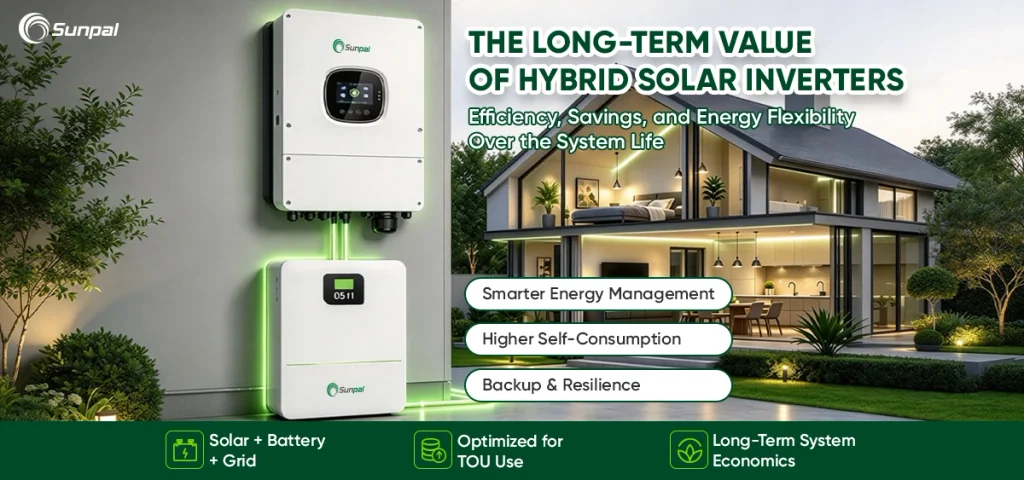
As solar energy systems continue to advance, hybrid solar inverters are taking on functions that go beyond simple DC-to-AC power conversion. By integrating photovoltaic generation, battery energy storage, grid interaction, and intelligent energy management, these systems enable users to flexibly generate, store, and consume electricity.
While these enhanced capabilities can increase upfront capital costs compared with standard grid-tied inverters, the long-term value of a hybrid solar system is not determined by hardware price alone. Key variables, including on-site self-consumption, electricity tariffs, battery cycling patterns, backup power requirements, and future energy demand, collectively shape the overall economics of solar-plus-storage systems.
What Makes a Hybrid Solar Inverter Different?
Unlike a conventional grid-tied inverter, a hybrid solar inverter can coordinate solar generation, battery storage, grid interaction, and connected loads within one system architecture.
Hybrid Inverter vs Grid-Tied Inverter: How They Work
How hybrid solar inverter works: energy flow diagram showing solar, inverter, battery, load, grid power path. Compare hybrid inverter vs standard grid-tied inverter.
✅ Hybrid Solar Inverter
Works as system hub. Solar DC power feeds the hybrid inverter. Power can flow three ways: supply local AC loads, charge battery storage, or export surplus energy to the utility grid.
⚡ Standard Grid-Tied Inverter
Only converts solar DC to AC for local loads and grid export. No battery connection path. The system will shut down during a grid outage and cannot use stored backup power.
Depending on the system design, it can manage:
- Solar PV generation
- Battery charging and discharging
- Residential or commercial loads
- Grid imports and exports
- Backup power during outages
- Time-of-use energy strategies
- Energy monitoring and management
This allows solar electricity to be used according to demand rather than only when it is generated.
For example, excess solar generation during the middle of the day can be directed to a battery instead of being exported immediately. The stored electricity can then be used later when solar production decreases or when electricity prices are higher.
Looking Beyond the Initial Investment
Hybrid solar inverter systems generally require more equipment and system integration than basic grid-tied systems. Total project costs can vary depending on inverter capacity, battery size, PV system size, installation requirements, electrical configuration, and local market conditions.
For this reason, comparing only the purchase price of a hybrid inverter with that of a conventional string inverter can provide an incomplete picture. The initial investment may include PV modules, the inverter, battery storage, mounting and electrical equipment, installation labor, permitting, interconnection, and other project-specific expenses. Permitting, inspection, engineering, and interconnection are often considered soft costs, and their impact varies by location and project requirements.
System size and equipment selection can also influence long-term economics. Larger systems generally require greater upfront investment but may provide more generation and storage capacity, while equipment efficiency, battery performance, durability, and operating requirements can affect long-term system value.
| Factor | Potential Impact on System Economics |
|---|---|
| Initial system cost | Determines the upfront capital requirement |
| Solar generation | Determines how much electricity is available for use or storage |
| Battery capacity | Determines how much excess energy can be shifted |
| Electricity rates | Influences the value of stored solar energy |
| Self-consumption | Determines how much solar power offsets grid purchases |
| Export compensation | Affects the value of electricity sent to the grid |
| Battery efficiency and degradation | Influences long-term usable storage |
| Financing costs | Can affect the effective project payback |
| Maintenance and replacement | Contributes to lifetime operating costs |
| Backup requirements | Adds resilience value beyond direct electricity-bill savings |
Understanding these factors provides a foundation for evaluating the long-term economics of a hybrid solar system.
Energy Savings Through Load Shifting
One of the key functions of a hybrid inverter is to shift electricity use from one period to another. This is particularly relevant in markets with time-of-use (TOU) electricity rates.
This operating strategy can support peak-valley energy arbitrage in markets with time-of-use electricity pricing.
A hybrid system can charge the battery when solar production exceeds immediate demand and discharge it when additional electricity is needed.
A simplified energy flow can be represented as:
Solar generation → Battery charging → Evening load → Reduced grid electricity purchases
Load Shifting and TOU Energy Arbitrage: Reducing Electricity Costs
Time-of-use (TOU) energy arbitrage: Solar charges batteries during daytime low-price periods. Batteries discharge to power home loads during evening peak tariff hours and cut electricity bills.
The financial benefit depends on the difference between the value of exported electricity and the cost of electricity that would otherwise be purchased from the grid. Actual savings vary according to utility tariffs, export-compensation rules, load profiles, battery efficiency, and system operating strategies.
Maximizing Solar Self-Consumption
Beyond shifting when electricity is used, a hybrid system can also change how much generated solar power is consumed on-site.
When solar production exceeds immediate demand, excess electricity may be exported to the grid. The compensation received depends on the applicable utility program or electricity market.
Solar Self-Consumption Explained
Adding battery storage changes how solar energy is used. See where your power goes — and how much stays on-site.
PV Without Battery
Low self-consumption. Most excess solar goes to the grid.
PV + Hybrid Inverter + Battery
High self-consumption. More solar energy stays at home.
PV Without Battery
- Direct Load: 40%
- Grid Export: 60%
- Self-Consumption: 40%
Excess solar is exported rather than stored.
PV + Hybrid Inverter + Battery
- Direct Load: 40%
- Battery Storage: 45%
- Grid Export: 15%
- Self-Consumption: 85%
Battery storage captures surplus solar for later use.
A hybrid system provides another option by storing part of the excess generation for later consumption.
This can increase the proportion of solar self-consumption and reduce reliance on grid electricity when solar production is low, and contribute to long term solar savings over the system's operating life.
However, hybrid systems do not automatically eliminate the need for grid electricity. Their economic performance depends on the relationship between solar generation, battery capacity, electricity demand, tariffs, and export policies.
Efficiency and System-Level Energy Performance
Efficiency is another important consideration when comparing inverter architectures.
A conventional string inverter may achieve high conversion efficiency because its primary function is converting PV electricity from DC to AC. A hybrid inverter performs additional energy-management functions and may use different conversion pathways depending on whether electricity is being used directly, stored, discharged from the battery, or exchanged with the grid.
A hybrid inverter is therefore not necessarily more efficient than a conventional string inverter in every operating mode. Its value comes from combining conversion efficiency with broader energy-management capabilities.
For solar-plus-storage systems, DC-coupled architectures can reduce unnecessary conversion steps in certain operating scenarios because solar energy can be directed to the battery without first being converted to AC and then converted back to DC.
The actual energy benefit depends on system architecture, equipment specifications, operating conditions, and battery characteristics. For this reason, system-level energy performance is often more meaningful than a single inverter efficiency specification.
Backup Power and Energy Resilience
Financial savings are only one part of the value proposition.
A properly designed hybrid solar system can also provide backup power when the grid is unavailable. During an outage, the inverter can disconnect protected loads from the grid and supply electricity from the battery and, where applicable, solar generation.
Backup Power and Energy Reliability
Hybrid inverter with STS auto-switching. Stay powered during grid outages using solar and battery reserves.
Grid-Tied Mode
- ✅ Grid connected
- ✅ PV charges battery
- ✅ Grid supplies loads
Normal daily operation.
Grid Outage Backup Mode
- ⚡ STS cuts grid automatically
- ⚡ PV + Battery supply critical loads
- ⚡ Power stays on during blackout
Energy resilience for power failures.
This capability can support critical loads such as:
- Refrigeration
- Communications equipment
- Lighting
- Security systems
- Internet equipment
- Essential commercial equipment
The value of backup power is difficult to express solely through electricity-bill savings because it depends on the consequences of an outage.
For residential and commercial applications, this combination of energy management, storage, and backup capability can provide greater flexibility and resilience. The actual value depends on system configuration, critical-load requirements, battery capacity, and local grid conditions.
As a result, resilience should be evaluated separately from direct energy savings when assessing the overall value of a hybrid system. Sunpal's solar and energy storage solutions integrate generation, storage, and energy management to support more flexible energy use and reliable power management across different applications.
Energy Flexibility for Future Needs
Energy flexibility is another important part of the long-term value of a hybrid inverter.
As properties add EV chargers, heat pumps, electric water heating, and other high-power loads, electricity demand can become more variable. A hybrid inverter can help coordinate these loads with solar generation and battery storage, depending on the equipment and system configuration.
Some hybrid inverter platforms can also support functions such as:
- EV charging integration
- Generator integration
- Microgrid operation
- Smart load management
- Virtual power plant participation
- Remote monitoring
- Energy management systems
These capabilities do not necessarily generate immediate financial returns. Their value lies partly in providing a system architecture that can adapt as energy consumption patterns change.
Evaluating the Long-Term Economics
Once the major cost and performance factors have been identified, the long-term economics of a hybrid solar inverter can be evaluated by comparing the system's net investment with its expected energy and financial benefits. This system-level approach is also important when assessing solar ROI, because the financial return of a solar-plus-storage system depends on more than the cost of the inverter itself.
A simplified assessment can use:
Annual Net Energy Benefits = Avoided Grid Electricity Costs + Applicable Export Revenue − Operating and Energy-Related Costs
A basic payback calculation can be expressed as:
Payback Period = Net System Cost ÷ Annual Net Savings
Hybrid Solar + Storage ROI & Payback Period Calculator
Hybrid solar inverter long‑term economics: calculate payback period and annual ROI for solar plus battery storage systems
⚠️ Annual net savings is zero or negative. The system will not pay back.
Calculation Results
Core Calculation Formulas
Annual Net Savings = Annual kWh × Tariff − Annual Maintenance
Payback Period (Years) = Total System Cost ÷ Annual Net Savings
ROI (%) = (Annual Net Savings ÷ Total System Cost) × 100
For a more comprehensive lifetime assessment, hybrid inverter ROI can be evaluated by considering the relationship between lifetime solar benefits and total system investment:
Lifetime ROI = (Lifetime Solar Benefits − Total Investment) ÷ Total Investment × 100%
Here, Net System Cost represents the project cost after applicable incentives, while Total Investment can include PV equipment, battery storage, the inverter, installation, financing, maintenance, replacement, and other project expenses. Lifetime benefits can include avoided electricity purchases, applicable export revenue, incentives, and other measurable economic benefits.
The actual outcome varies from project to project. A property with high evening electricity demand and time-of-use pricing may place greater value on battery-based load shifting, while a system with lower evening demand and favorable export compensation may have different economics. For projects pursuing greater energy independence, energy independence cost should also be considered alongside equipment costs, storage capacity, and expected energy savings.
Hybrid systems are therefore not automatically the most economical option for every project. Their long-term value depends on the relationship between system cost, energy production, electricity rates, storage requirements, export policies, operating patterns, and the project's specific energy objectives.
The Role of Incentives
Government incentives, tax programs, utility rebates, grants, and energy-storage programs can reduce the effective cost of qualifying solar-plus-storage projects. However, eligibility and benefit levels vary by location, project type, installation date, system configuration, and program requirements.
Net metering and export compensation can also affect project economics. Excess solar electricity may generate credits or other compensation, while time-of-use rates and export policies can influence the value of sending power to the grid. See Myth vs Reality: Net Metering Payback in Time-of-Use Markets for further discussion.
System size and equipment selection also influence long-term economics. Larger systems may require higher upfront investment but can provide greater generation and storage capacity, while equipment efficiency, battery performance, and durability can affect long-term savings and operating costs.
Project owners should verify current incentive and utility program requirements before including these benefits in payback or ROI calculations.
Conclusion
The long-term value of a hybrid solar inverter extends well beyond its initial hardware investment. By integrating PV generation, battery storage, intelligent energy management, and backup power capabilities, hybrid systems provide greater flexibility in how electricity is generated, stored, and consumed while supporting more resilient energy management.
For project developers, installers, and system owners, hybrid inverter selection should not rely solely on equipment price comparisons. A comprehensive assessment should consider system compatibility, energy management capabilities, battery integration, conversion efficiency, backup power requirements, and long-term operating costs.
Actual economic returns are influenced by electricity tariffs, system configuration, battery performance, on-site self-consumption, export compensation, applicable incentives, and future energy demand. Depending on these factors, the value of a hybrid system may come from reducing grid electricity purchases, shifting energy use, increasing solar self-consumption, or maintaining essential loads during grid interruptions.
As solar-plus-storage systems become more integrated and intelligent, hybrid inverters can provide an adaptable foundation for changing energy needs. Their long-term value lies in combining energy efficiency, cost savings, energy flexibility, and reliable power management. Sunpal provides solar and energy storage solutions designed to support efficient energy utilization, flexible system operation, and dependable power management across diverse applications.