
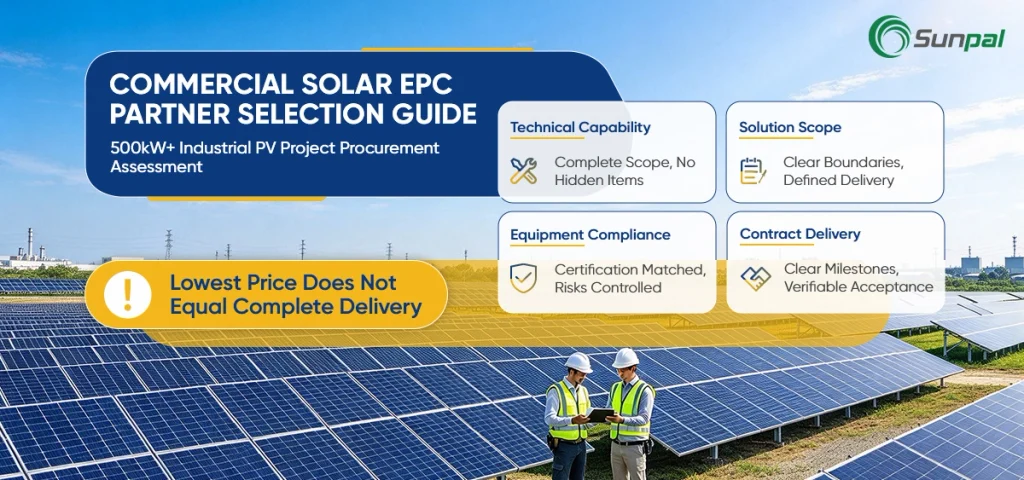
Selecting the right Engineering, Procurement, and Construction (EPC) partner is one of the most important decisions when developing a 500kW solar system or larger commercial solar project. For factories, warehouses, logistics centers, and commercial property owners, the EPC partner influences project cost, equipment quality, construction schedules, regulatory compliance, and long-term system performance.
As commercial solar systems become more integrated, project requirements may extend beyond conventional rooftop photovoltaic (PV) installations to ground-mounted arrays, battery energy storage systems (BESS), energy management systems (EMS), and photovoltaic facade systems. Each configuration introduces different engineering responsibilities, procurement requirements, and delivery risks.
However, choosing an EPC contractor should not be based on the lowest quotation alone. A competitive proposal must clearly define the work included, equipment specifications, grid-connection responsibilities, commissioning requirements, warranties, and exclusions. Without a consistent evaluation process, two proposals for the same commercial photovoltaic system may appear comparable while covering substantially different scopes of work.
This guide explains how businesses can evaluate commercial solar EPC partners, standardize competing proposals, verify supplier reliability, and establish contractual safeguards before committing to a project.
What Does a Commercial Solar EPC Partner Do?
A commercial solar EPC partner coordinates the engineering, procurement, and construction activities required to deliver a photovoltaic project. Depending on the contract, the EPC contractor may manage the project from preliminary engineering through equipment purchasing, installation, commissioning, and final handover.
For a 500kW solar system, these responsibilities typically involve several interconnected workstreams.
Engineering: The EPC team develops or coordinates the technical design, including site assessments, structural evaluations, electrical drawings, equipment specifications, protection requirements, and grid-interconnection documentation.
Procurement: The contractor selects and purchases solar modules, inverters, mounting structures, cables, switchgear, monitoring equipment, and other required components. Projects incorporating storage may also require battery systems, power conversion equipment, and EMS integration.
Construction: Installation activities include mounting structures, PV modules, electrical equipment, cable routing, grounding, equipment integration, and construction quality control.
Commissioning and handover: The EPC team coordinates applicable inspections, electrical tests, functional checks, grid-connection procedures, monitoring configuration, documentation, and operational training.
The precise allocation of these responsibilities depends on the contract and local regulations.
EPC Contractor vs. Solar Equipment Supplier
An equipment supplier primarily provides products, technical documentation, and the agreed level of product support. An EPC contractor generally takes responsibility for a broader package of engineering, construction, and project delivery activities.
| Evaluation factor | Solar equipment supplier | Commercial solar EPC partner |
|---|---|---|
| Primary responsibility | Product supply and agreed technical support | Contracted project delivery and coordination |
| Equipment procurement | Supplies specified products | Coordinates procurement within the agreed scope |
| Engineering | Provides product specifications and application guidance | Develops or coordinates project engineering |
| Installation | Usually excluded unless separately agreed | Included when specified in the contract |
| Grid connection | Product-level support where applicable | Coordinates assigned interconnection work |
| Commissioning | Equipment-level assistance may be available | Coordinates project commissioning within scope |
| Project warranties | Product warranties | Contractual workmanship and project obligations, as agreed |
For buyers evaluating commercial solar systems, it is important to establish whether the selected company is acting as a product supplier, an EPC contractor, or both. This distinction helps prevent gaps in responsibility when technical or construction issues arise.
What Experience Should a Commercial Solar EPC Have?
An EPC partner should demonstrate experience relevant to the proposed project rather than relying exclusively on general renewable energy credentials.
A contractor experienced in small commercial rooftops may not have the same capabilities as a team delivering a 500kW+ solar system with medium-voltage equipment, complex utility coordination, or integrated battery storage.
When reviewing project experience, focus on the following areas.
Comparable project capacity: Request references for projects with similar installed capacity, electrical architecture, and construction complexity. A completed project of comparable scale provides more useful evidence than a general claim of extensive experience.
Similar site conditions: Industrial rooftops, distribution warehouses, commercial parks, and ground-mounted installations present different structural, access, and construction challenges. Look for relevant experience with the actual project environment.
Grid-interconnection experience: Ask whether the EPC has managed the applicable utility approval process, protection requirements, transformer coordination, export limitations, and commissioning procedures.
Storage integration: If the project includes BESS, verify experience with battery integration, operating controls, safety requirements, monitoring, and the interaction between PV generation and facility loads.
Project management capability: Review how the contractor manages procurement lead times, subcontractors, site safety, construction milestones, quality assurance, and change requests.
Operational support: Ask how the company handles technical issues after handover, including warranty claims, replacement equipment, remote monitoring, and maintenance coordination.
How to Verify Project References
Ask prospective EPC partners for a small number of relevant, verifiable references rather than a long list of unsubstantiated project claims.
Where permitted, request project locations, completion dates, installed capacities, scope descriptions, customer references, and evidence of successful commissioning. Confirm whether the contractor performed the work directly or participated as a subcontractor, equipment supplier, or consultant.
A credible reference should demonstrate what the company actually delivered, which responsibilities it accepted, and whether the completed project resembles the proposed installation.
How Should You Evaluate EPC Technical Capabilities?
Technical evaluation should determine whether the EPC partner can deliver a compliant, maintainable, and appropriately specified commercial photovoltaic system.
Buyers do not necessarily need to perform detailed engineering calculations themselves. Instead, they should confirm that the contractor has qualified personnel, documented design processes, and the ability to explain its technical decisions.
Review the Engineering Approach
Request a preliminary design package or technical proposal appropriate to the procurement stage. Our Commercial PV System Design Guide provides additional guidance on these design considerations. Depending on the project, it may include:
- Site assessment findings and structural review requirements.
- Proposed PV module and inverter specifications.
- Preliminary system layout and electrical architecture.
- Grid-interconnection assumptions and utility approval responsibilities.
- Protection, grounding, and monitoring concepts.
- Battery storage and EMS integration requirements, where applicable.
- Expected energy production and the assumptions behind the estimate.
- Commissioning, testing, maintenance, and handover plans.
For a 500kW solar system, the EPC should clearly distinguish between preliminary estimates and final engineering deliverables. Detailed string configurations, cable sizing, protection settings, and equipment selections must be validated during the appropriate design stage.
Evaluate Design Flexibility and Integration
The contractor should explain how its proposed configuration responds to the facility's operating requirements, roof conditions, grid restrictions, and future expansion plans.
For example, a factory with substantial daytime consumption may prioritize solar self-consumption, while a facility with significant evening demand may investigate battery storage. A commercial building with limited roof space may evaluate ground-mounted generation, solar canopies, or photovoltaic facade systems.
The objective is not to select the most complex design, but to confirm that the EPC has evaluated suitable options, documented the trade-offs, and linked its recommendations to the project's actual requirements. For a 500kW+ project, this evaluation should also account for transformer capacity, protection coordination, grid-interconnection constraints, and potential battery integration.
Assess Monitoring and Maintenance Provisions
Monitoring should be specified in practical terms rather than described only as an advanced digital feature.
Confirm which devices will be monitored, what performance data will be available, how alarms will be handled, who can access the platform, and whether remote support is included after commissioning.
A technically sound proposal should also explain how equipment can be serviced or replaced and whether spare parts, software access, and technical documentation will remain available throughout the agreed support period.
How to Compare EPC Proposals and Project Scope
Comparing EPC quotations requires a standardized scope of work. Without one, the lowest-priced proposal may exclude essential engineering, installation, grid-connection, or commissioning activities that appear in competing offers.
Proposal scope normalization is the process of placing competing EPC proposals on a consistent basis by defining the same project requirements, deliverables, assumptions, and exclusions for every bidder.
For a 500kW solar system, this process should begin before final quotations are requested.
Establish a Common Request for Proposal
Prepare a common request for proposal (RFP) containing the information every bidder needs to price the same project.
The RFP should identify the project location, target system capacity, available installation area, electricity demand, grid conditions, preferred equipment requirements, expected delivery schedule, and required project documentation.
Where the system design is not yet finalized, the request for proposal (RFP) should clearly identify which items the EPC contractor is expected to engineer and which assumptions should be used for preliminary pricing. The U.S. Department of Energy's guidance on procuring a solar photovoltaic system can also help project owners establish technical requirements and evaluate contractor proposals on a more consistent basis.
Normalize the Commercial and Technical Scope
Use a comparison matrix to identify differences between proposals.
| Scope category | What buyers should compare |
|---|---|
| Engineering | Site surveys, structural assessment, electrical design, drawings, calculations, and design revisions |
| Equipment | Module and inverter models, mounting structures, cables, switchgear, monitoring, and storage components |
| Installation | Mechanical installation, electrical works, labor, lifting equipment, access equipment, and site logistics |
| Grid connection | Utility applications, studies, protection coordination, transformer modifications, metering, and assigned fees |
| Commissioning | Inspection, electrical testing, functional tests, grid approval coordination, and commissioning records |
| Project management | Permits, subcontractor coordination, safety management, schedule reporting, and quality control |
| Warranties | Product warranties, workmanship coverage, performance commitments, exclusions, and claim procedures |
| Handover and support | As-built drawings, manuals, training, monitoring access, maintenance plans, and after-sales assistance |
| Exclusions | Roof reinforcement, utility upgrades, taxes, permits, civil works, and other items not included in the price |
Each bidder should confirm whether an item is included, excluded, provisional, or subject to a separate quotation. This prevents assumptions from being mistaken for contractual commitments.
Compare Deliverables, Not Just Equipment Lists
Two EPC proposals may specify similar solar modules and inverters but differ considerably in project value.
One bidder may include structural surveys, detailed electrical design, utility coordination, and comprehensive commissioning. Another may price only equipment and basic installation, leaving the buyer to arrange the remaining work.
The comparison should therefore establish the complete scope, not simply compare component brands or the total number of equipment items.
For battery-integrated projects, normalize the battery power rating, usable energy capacity, control functions, safety provisions, warranty conditions, and commissioning scope as well.
A properly normalized proposal allows procurement teams to identify genuine cost differences and negotiate with a clearer understanding of the responsibilities each price covers.
Which Certifications, References, and Documents Should Be Verified?
Credentials and documentation help buyers assess whether an EPC partner is qualified to perform the proposed work. However, the required licenses, certifications, and approvals depend on the project location, contract structure, and activities being performed.
Verification should cover both the contractor and the major equipment included in the commercial photovoltaic system.
Contractor Credentials and Insurance
Check the following items where applicable:
- Business registration and relevant electrical or construction licenses.
- Required professional engineering credentials and responsible technical personnel.
- Contractor liability insurance and workers' compensation or equivalent coverage.
- Site-specific health, safety, and environmental procedures.
- Subcontractor qualifications and insurance arrangements.
- Any locally required solar installation, grid-interconnection, or electrical certifications.
Do not assume that a certification from one jurisdiction automatically authorizes a contractor to work in another.
Equipment Compliance and Technical Documents
Request the relevant documentation for PV modules, inverters, mounting structures, switchgear, battery systems, and other major components.
Depending on the market and product category, this may include applicable safety and performance certifications, product datasheets, warranty documents, installation manuals, declarations of conformity, and test reports.
For example, PV modules and inverters must satisfy the standards and grid requirements applicable to the installation location. Battery systems may also be subject to specific electrical, fire-safety, transportation, and installation requirements.
Confirm that documentation applies to the exact model being quoted rather than a similar product from the same manufacturer.
References and Financial Due Diligence
Where the project size justifies it, buyers may also review the contractor's financial stability, business continuity arrangements, supplier relationships, and ability to manage procurement commitments.
A low-priced offer provides limited protection if the contractor cannot obtain equipment, maintain insurance, complete construction, or support warranty claims.
The verification process should produce a clear record of the credentials, references, technical documents, and commercial information reviewed before contract award.
How Should Equipment Quality and Supplier Reliability Be Assessed?
Equipment selection affects project reliability, construction schedules, maintenance requirements, and long-term operating costs. An EPC partner should be able to demonstrate that its proposed components are suitable for the application and supported by a credible supply chain.
Evaluate the Complete Equipment Package
For PV modules, review rated power, efficiency, electrical characteristics, mechanical loading limits, degradation terms, and product warranties.
For inverters, examine DC input limits, MPPT configuration, conversion efficiency, grid-support functions, operating conditions, monitoring, and service availability.
For BESS, assess usable energy capacity, charge and discharge power, operating limits, battery management, thermal management, safety provisions, degradation assumptions, and warranty conditions.
For monitoring and EMS equipment, clarify communications compatibility, data access, control functions, cybersecurity responsibilities, and ongoing software or service fees.
The exact criteria will depend on the project. Buyers should avoid accepting broad statements such as "Tier 1 equipment" or "premium components" as substitutes for specific model numbers and documented specifications.
Check Delivery and After-Sales Reliability
Request a procurement schedule showing expected manufacturing, shipping, delivery, and installation milestones. Identify components with long lead times and determine what happens if a quoted model becomes unavailable.
The EPC should explain its substitution process, including whether the buyer must approve changes and how equivalent performance and certification will be demonstrated.
Also confirm the process for warranty claims, defective equipment, spare parts, technical escalation, and replacement labor.
For a 500kW+ solar system, the reliability of the entire delivery chain matters. A high-quality module or inverter does not eliminate project risk if the selected components are incompatible, delayed, or inadequately supported.
How Do EPC Contracts Define Cost, Schedule, and Responsibility?
The EPC contract converts the proposal into enforceable project obligations. Buyers should ensure that the agreement clearly defines deliverables, commercial terms, technical acceptance criteria, and responsibility for delays or scope changes.
Define the Contract Scope
The agreement should identify the equipment models, engineering deliverables, installation work, project boundaries, interconnection responsibilities, commissioning procedures, and handover documents.
Any exclusions or provisional items should be listed explicitly. Avoid relying on informal assurances that an omitted activity will be handled later.
Establish Cost and Payment Terms
Payment milestones should correspond to verifiable project progress, such as approved design deliverables, equipment delivery, installation completion, successful testing, or contractual acceptance.
The contract should also clarify taxes, shipping, customs where applicable, change orders, provisional sums, and the process for approving additional costs.
Buyers should understand what happens if a site condition, utility requirement, or equipment substitution changes the original project price.
Set Schedule and Acceptance Requirements
A realistic schedule should include design review, permitting, utility coordination, equipment procurement, construction, inspection, commissioning, and handover.
The contract should distinguish between milestones controlled by the EPC and activities dependent on third parties, such as utility approvals. It should also define notice requirements, delay responsibilities, and procedures for schedule changes.
Acceptance criteria should specify which inspections and tests must be completed, what documentation is required, how defects are resolved, and when final acceptance occurs.
Clarify Performance and Warranty Obligations
Performance commitments must state the measurement method, assumptions, exclusions, and remedies if agreed requirements are not met.
Where energy yield is guaranteed, the parties should define the reference conditions and treatment of weather variability, grid curtailment, force majeure, and other relevant factors.
Likewise, distinguish product warranties issued by manufacturers from workmanship warranties and project-level obligations provided by the EPC contractor.
Legal and technical reviews before signing can help ensure that these terms are consistent with the project's commercial objectives and applicable law.
What Are the Most Common EPC Selection Risks?
Many commercial solar disputes originate from unclear scope definitions, incomplete technical requirements, or unrealistic commercial assumptions rather than from the basic concept of solar generation.
The following risks deserve particular attention during procurement.
Incomplete quotations: A low initial price may exclude structural reinforcement, utility upgrades, electrical protection, commissioning, or other essential activities. Normalize the scope before comparing totals.
Unspecified equipment: Proposals that identify only generic product categories make it difficult to verify performance, certifications, warranties, or compatibility. Request exact model numbers and approved substitution procedures.
Unverified performance claims: Estimated energy production and financial returns depend on site conditions, electricity tariffs, system losses, and operating assumptions. Request documented calculations rather than relying on guaranteed savings claims without supporting terms.
Unclear grid responsibilities: Unassigned utility applications, interconnection studies, transformer modifications, or export-control requirements can cause delays and additional costs.
Unrealistic delivery schedules: Procurement lead times, permitting, site access, and utility approval may affect the project schedule. Require a milestone-based plan with identified dependencies.
Weak after-sales arrangements: Unclear warranty handling, limited spare-parts access, or missing monitoring support may increase long-term operating risk.
Uncontrolled substitutions: Replacing equipment without approval can change electrical compatibility, system performance, certification status, and warranty coverage.
Unbalanced contract terms: Large advance payments, vague acceptance criteria, and limited remedies for non-performance may leave the buyer exposed if delivery problems arise.
A disciplined evaluation process should identify these issues before contract award, when scope and commercial terms are easier to clarify.
Commercial Solar EPC Evaluation Checklist
Use this checklist to verify that key requirements have been addressed before selecting a commercial solar EPC partner.
Project experience
- Comparable project references and installed capacities verified.
- Contractor's role and delivery responsibilities confirmed.
- Relevant site, grid, and storage integration experience verified where applicable.
Technical capability
- Qualified engineering personnel and design responsibilities confirmed.
- Proposed equipment specifications and technical requirements documented.
- Commissioning, monitoring, and maintenance responsibilities defined.
Credentials and supply chain
- Applicable licenses, credentials, and insurance verified.
- Equipment certifications and warranty documents reviewed.
- Delivery schedules and equipment substitution procedures confirmed.
- Warranty claims and after-sales support arrangements clarified.
Proposal and contract
- All bidders evaluated against the same RFP requirements.
- Proposal scope normalization completed.
- Inclusions, exclusions, assumptions, and provisional costs documented.
- Payment milestones and delivery responsibilities defined.
- Change control, acceptance criteria, and warranty obligations specified.
- Handover documentation and support included in the agreed scope.
Use this checklist alongside technical, financial, and contractual reviews. The final selection should reflect the project's specific requirements, the completeness of each proposal, and the level of delivery risk the business is prepared to accept.
How to Compare EPC Bids and Assess Project Value
The best EPC proposal is not necessarily the cheapest one. A more useful comparison considers the complete delivered cost, the certainty of the scope, the quality of the equipment package, and the risks that remain with the buyer.
Use a Normalized Bid Comparison
Consider a hypothetical procurement exercise involving three bids for the same commercial PV project.
The figures below are illustrative only. They are not actual supplier quotations, market benchmarks, or verified project results.
| Cost or scope item | Bid A | Bid B | Bid C |
|---|---|---|---|
| Quoted EPC price | $400,000 | $425,000 | $440,000 |
| Structural assessment | Included | Included | Included |
| Utility upgrades | Excluded | Included | Included |
| Commissioning and handover | Basic scope | Full stated scope | Full stated scope |
| Monitoring setup | Additional cost | Included | Included |
| Scope clarity | Several exclusions | Clearly itemized | Clearly itemized |
In this example, Bid A has the lowest headline price, but the buyer must account for utility upgrades, additional monitoring costs, and the extent of commissioning work before comparing it fairly with the other offers.
A normalized comparison should identify the additional costs necessary to bring every bid to the same required scope. Where a cost cannot yet be confirmed, list it as a provisional amount or unresolved commercial risk rather than assuming it is zero.
Assess Total Project Value
After scope normalization, evaluate each bid against the following factors:
- Total expected project cost, including identified exclusions and provisional items.
- Equipment specifications, compatibility, and warranty coverage.
- Technical design quality and compliance with the project requirements.
- Procurement certainty and the credibility of the delivery schedule.
- Commissioning, documentation, and handover completeness.
- Operational support, maintenance requirements, and potential replacement costs.
- Contractual remedies, payment exposure, and responsibility for delays.
If appropriate, use a weighted scoring matrix to compare the shortlisted EPC partners. Assign greater weight to factors that matter most to the project, such as technical compliance, scope completeness, delivery capability, or lifecycle cost.
For larger commercial solar systems, this structured method can help procurement teams explain why a proposal offers better overall value even when its initial price is not the lowest.
Any financial model should be based on documented project assumptions. If no verified operating data or comparable completed-project evidence is available, label the analysis as a hypothetical procurement example rather than presenting it as a real-world result.
Frequently Asked Questions
What is the main difference between a commercial solar EPC partner and an equipment supplier?
An equipment supplier sells specific hardware, whereas an EPC partner delivers a complete turnkey solar power plant. A commercial solar EPC partner takes full single-point contractual responsibility for Engineering (3-phase electrical & structural design), Procurement (Tier-1 hardware sourcing), Construction (installation & safety), Commissioning, and Grid Interconnection Handover. An equipment supplier only provides product-level warranties and basic technical support.
How many commercial solar EPC proposals should a business compare before selecting a partner?
A business should typically compare 3 to 5 detailed, qualified EPC proposals. Evaluating 3 to 5 standardized proposals provides clear market price transparency and reveals differences in engineering methodology (such as DC/AC oversizing ratios, cable loss calculations, and inverter topologies) without overwhelming decision-makers with non-comparable bids.
How can a buyer verify a commercial solar EPC contractor's project experience?
Buyers should request a verified project portfolio detailing installed capacities (kWp/MWp), grid connection dates, roof construction types, drone imagery, and client contacts. Additionally, confirm that the contractor holds active electrical contracting licenses, ISO 9001/45001 safety accreditations, and non-recourse bankability credentials with financial institutions.
Should an independent engineer (IE) review a commercial solar EPC proposal?
Yes, hiring an Independent Engineer (IE) is highly recommended for projects exceeding 300 kW, substantial capital investments, or complex BESS integrations. An independent technical review validates structural load assumptions, PVsyst yield simulations (PR benchmarks), component compatibility, single-line electrical diagrams (SLD), and contract scope gaps prior to contract award.
How should buyers evaluate and compare commercial solar EPC warranties?
- Buyers must evaluate warranties across three distinct layers:
- EPC Workmanship Warranty (typically 2 to 5 years): Covers installation defects, roof flashing, and AC/DC wiring integrity.
- Manufacturer Product Warranties (12 to 25 years): Cover module material defects, inverter failures, and racking corrosion.
- System Performance Guarantees (20 to 25 years): Guarantees minimum energy yield (Performance Ratio / PR ≥ 80%) backed by EPC performance liquidations or third-party insurance.
Can a single EPC partner deliver a 500kW+ solar system with battery storage (BESS) integration?
Yes, provided the EPC partner possesses specialized C&I microgrid and energy management system (EMS) engineering capabilities. Delivering a 500kWp PV + C&I BESS system requires expertise in multi-MPPT string inverter control, closed-loop battery BMS communication, generator auto-start logic, dynamic zero-export grid limiting, and fire suppression safety compliance (NFPA 855 / UL 9540A).
What key requirements should be included in a commercial solar EPC Request for Proposal (RFP)?
- A comprehensive commercial EPC RFP must include:
- Site & Load Data: Geographic location, roof CAD/drone imagery, structural load limits, and 12-month 15-minute interval electricity bills.
- Technical & Equipment Specifications: Target AC/DC capacity, preferred Tier-1 hardware brands, grid connection voltage, and SCADA monitoring requirements.
- Commercial & Delivery Terms: Itemized pricing format, milestone schedule, performance guarantee terms, warranty expectations, and an explicit list of contractual exclusions.
Streamline Your Commercial Solar Supplier Evaluation With SUNPAL ESS
Commercial solar procurement can become complicated when EPC proposals use different technical assumptions, exclude different services, or present prices that are difficult to compare directly. Whether a business is evaluating a 500 kW solar system, planning a larger installation, or considering PV combined with battery storage, a structured supplier evaluation process helps clarify project scope, responsibilities, and commercial risks before contract negotiations begin.
SUNPAL ESS provides solar PV products and supports discussions about commercial and industrial solar requirements. For businesses comparing suppliers or preparing an EPC procurement plan, defining project expectations in advance can make proposal reviews more consistent and help identify differences in equipment specifications, service coverage, and delivery responsibilities.
Before requesting a project consultation, prepare the following information:
- Project location: Country, region, and relevant site conditions.
- Target capacity: Planned PV capacity and potential future expansion.
- Application: Factory, warehouse, commercial building, industrial facility, or another site type.
- Technical requirements: Preferred equipment specifications, grid conditions, and any battery storage or EMS requirements.
- Procurement plan: Expected project timeline, current purchasing stage, and required scope of support.
A successful EPC selection process requires clear project scope, verified supplier capabilities, and well-defined contractual responsibilities. Comparing equivalent deliverables and total project costs helps businesses make informed procurement decisions and reduce project delivery risks.